What profit margin does my shop need to sell well?
Buyers aren't buying your equipment. They're buying your earnings. The margin your shop produces tells a buyer how much money they can expect to make after they take over, and it's the foundation of almost every valuation method a buyer or a broker will use. Understanding what margin matters, what a buyer is looking for and where your shop stands is the most useful thing you can do before you have a price conversation with anyone.
If this sounds like youYou're thinking about what your shop might be worth and you've heard that buyers care about profit margin. But which margin? Labor margin? Net profit? And what does it actually need to be for someone to write a real check? The numbers feel like a moving target and nobody's giving you a straight answer.
What you can do.
Labor margin and parts margin
Labor margin is what's left of your labor revenue after you pay your technicians. If you charge out $100 in labor and pay your tech $35 to do the job, your labor margin on that job is 65%. Across the whole shop, buyers typically want to see a labor margin above 60%, and anything above 65% reads as healthy. Parts margin is the difference between what you charge customers for parts and what you paid for them. A gross parts margin somewhere in the range of 40% to 50% is common for a well run independent shop. These two numbers together tell a buyer whether the shop is priced and staffed in a way that holds up. A shop where the owner is also the top tech, putting in 50 hours a week, often shows a great labor margin that won't survive the owner walking out the door. Buyers know that, and they'll ask.
Net profit and what buyers actually pay on
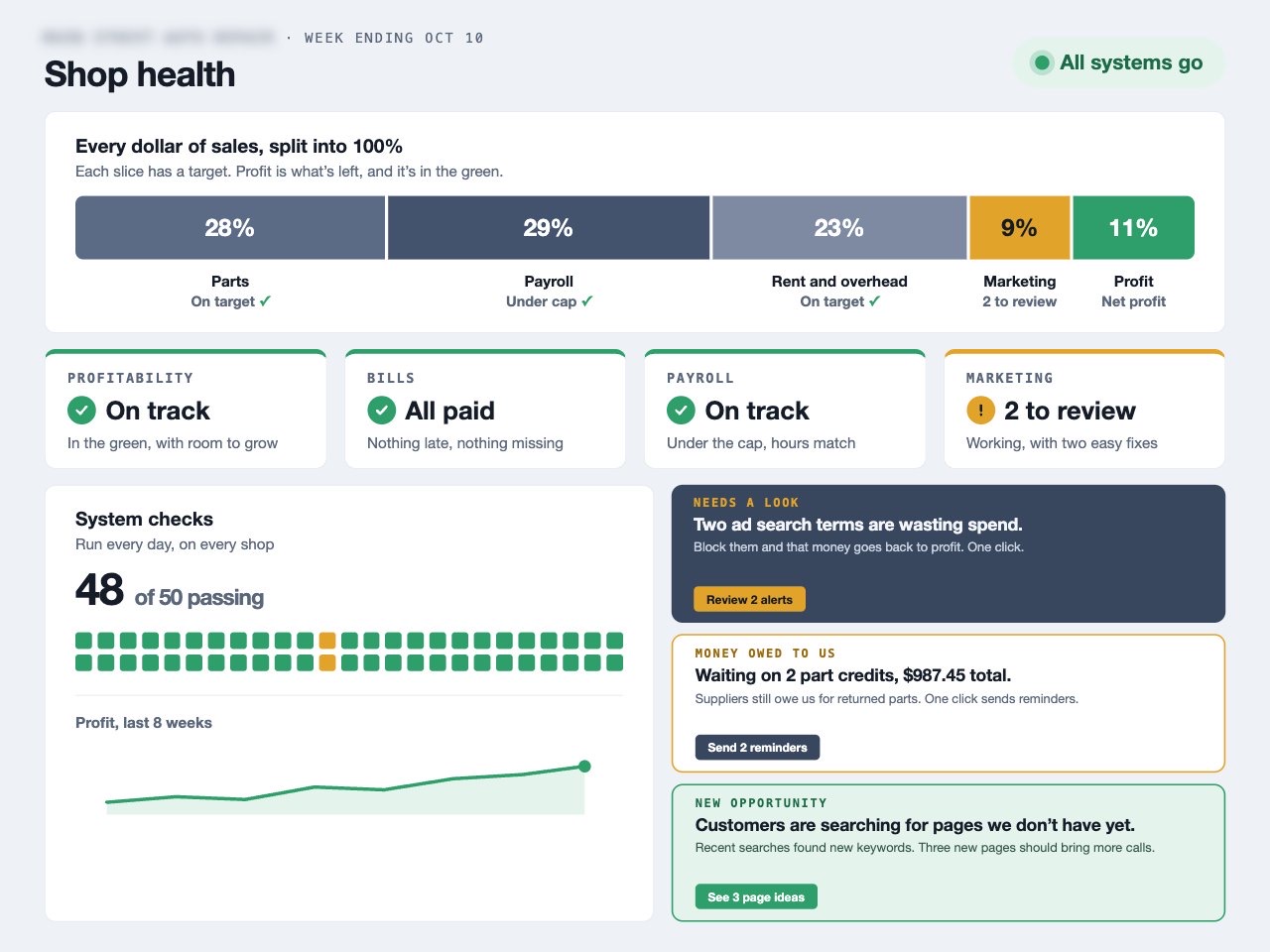
Net profit is revenue less everything: payroll, parts, rent, insurance, supplies, marketing and every other cost the business carries. For a small independent shop in Massachusetts or Connecticut, a net profit margin somewhere in the range of 10% to 20% of total revenue is a range where buyers will take you seriously. Below 10% the numbers get harder to defend at a strong price. Above 20% a buyer will want to know why, because margins that high for a small shop sometimes mean the owner is underpaying themselves or skipping things the new owner will have to pay for. What buyers typically pay a multiple on is seller's discretionary earnings, which is net profit added back to the owner's salary, owner perks and any one time items that won't repeat after the sale. That adjusted number is what gets multiplied to arrive at a price. The multiple for a well run auto repair shop in this region is generally somewhere between 2.5 and 4 times seller's discretionary earnings, though the right number depends on the specific shop, the market and the buyer.
If your margins aren't where they need to be
The earlier you know, the more you can do about it. A shop with thin margins has a few levers: raising labor rates, tightening parts pricing, reducing technician turnover that drives unbillable time, and cutting costs that don't directly support revenue. None of those happen overnight, but over 12 to 24 months they can meaningfully change what your shop looks like to a buyer. The flip side is that cleaning up margin too aggressively right before a sale can look like what it is. Buyers and their accountants look at 2 to 3 years of financials. A sudden jump in net profit in year three of a three year review often comes with more questions, not a higher offer. The cleaner story is a shop that's been moving in the right direction for a while. If you're 2 or more years out from selling, there's real room to improve what a buyer sees.
What to watch for.
- Owner salary matters more than most sellers realize. If you've been paying yourself below market to show more profit, a buyer will add back a market rate salary before they value the shop, which reduces the number. If you've been paying yourself above market, they'll do the same thing in the other direction. Know what a shop manager in your market actually earns.
- One year of strong margins doesn't fix three years of thin ones in a buyer's eyes. Banks that finance these purchases want to see 2 to 3 years of consistent earnings. A single great year is a yellow flag, not a green light.
- Rent is one of the costs that changes what your margins look like to an outsider. If you own the building and charge the business rent at or below market, a buyer will add back a market rate rent expense when they look at the numbers. This can change the picture significantly. Know what market rent looks like for your location before you have that conversation.
Owner to owner, and it stays private.
Lotus PE helps auto repair shop owners in Massachusetts and Connecticut understand what their numbers look like to a buyer before they ever sit across from one. We look at what you have, what it means and what, if anything, is worth fixing before you start the process. Talk to James to get that conversation started.
 James Stephenson
Lotus, Massachusetts and Connecticut
Quick answers.
What's the difference between gross profit margin and net profit margin?
Gross profit is revenue less the direct costs of doing the work: parts and technician labor. Net profit is what's left after every other cost, including rent, insurance, payroll for non technicians, utilities and everything else. Buyers look at both, but it's net profit and seller's discretionary earnings that drive the price.
Do buyers look at revenue or profit when they set a price?
Profit, not revenue. A shop doing $2 million in revenue with thin margins will often sell for less than a shop doing $1.2 million with clean margins and a strong discretionary earnings number. Revenue matters as a sign of scale, but profit is what a buyer is actually buying.
What if my shop has good revenue but my profit looks low because of how I've run things?
That's common, and it's one of the things a sell side advisor helps untangle. Some of what looks like low profit is legitimate cost. Some of it is owner decisions that can be explained or normalized. Getting clear on what the adjusted earnings number really is, before a buyer runs their own numbers, puts you in a much stronger position.
Will a buyer want to see my tax returns?
Yes. Any serious buyer will ask for 2 to 3 years of tax returns along with your profit and loss statements. If your reported income is significantly lower than what you actually take out of the business, that gap is worth understanding before you get into due diligence. Talk to your CPA about what your returns show and what can be legitimately explained.
Is there a margin number that makes a shop unsellable?
Very thin margins don't make a shop unsellable, but they change the terms significantly. A buyer paying for a business that barely earns a living will want a price that reflects that risk, usually a lower multiple or a deal with more of the price tied to future performance. Knowing where you stand gives you the choice of whether to sell now or improve first.
Thinking about what comes next for your shop or building?
Tell James a little about it. Only James reads it, and the conversation stays private. No pressure, no broker and no mailing list.